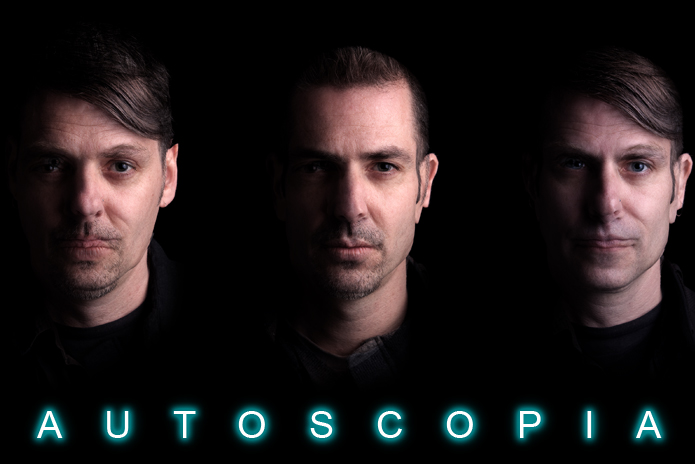
In the psychological condition of autoscopia, I literally see myself. Autoscopia entails alienation (I am I/I am not I), division (I am one/I am two), disembodiment (I am outside my own body) and inorganic vision (I see my own body but not with my own eyes). There is also a variant known as 'negative autoscopia' (I cannot see my own reflection in a mirror). The doppelgänger and the vampire are two ancient images of such an experience: the doppelgänger is the literal body-double of oneself; a vampire cannot appear in a mirror.
Autoscopia’s Second Life portraits are built using data from internet-based 'vanity searches' conducted within the Second Life installation. Each name creates a unique outcome composed of 27 'limbs'. Each limb is fed data from websites such as Google, Facebook, Twitter etc, with colours, geometry and audio affected by variations in search volume. Data is then re-published via discrete web pages automatically composed through text and images collected during the search. The identity created will thereafter be reincorporated into future search results. Each portrait also 'Tweets' its existence on Twitter, with both the web pages and Tweets looping back into future portraits.
The real-world Autoscopia work installed at the National Portrait Gallery in Canberra is a video portrait of the artists, displayed via a wall-mounted, flat-screen television, along with a digital still print (seen above). Three video channels (one per collaborator) are combined to form a composite of the artists as a (dis)unified whole.
Autoscopia is produced by Adam Nash, Christopher Dodds and Justin Clemens.
Click here to view full essay (300 Kb PDF)
- - -
Photography Rom Anthonis, web design Angus Bremner, Icon.Inc